Your next step to growth comes with free delivery on orders £39 and up.

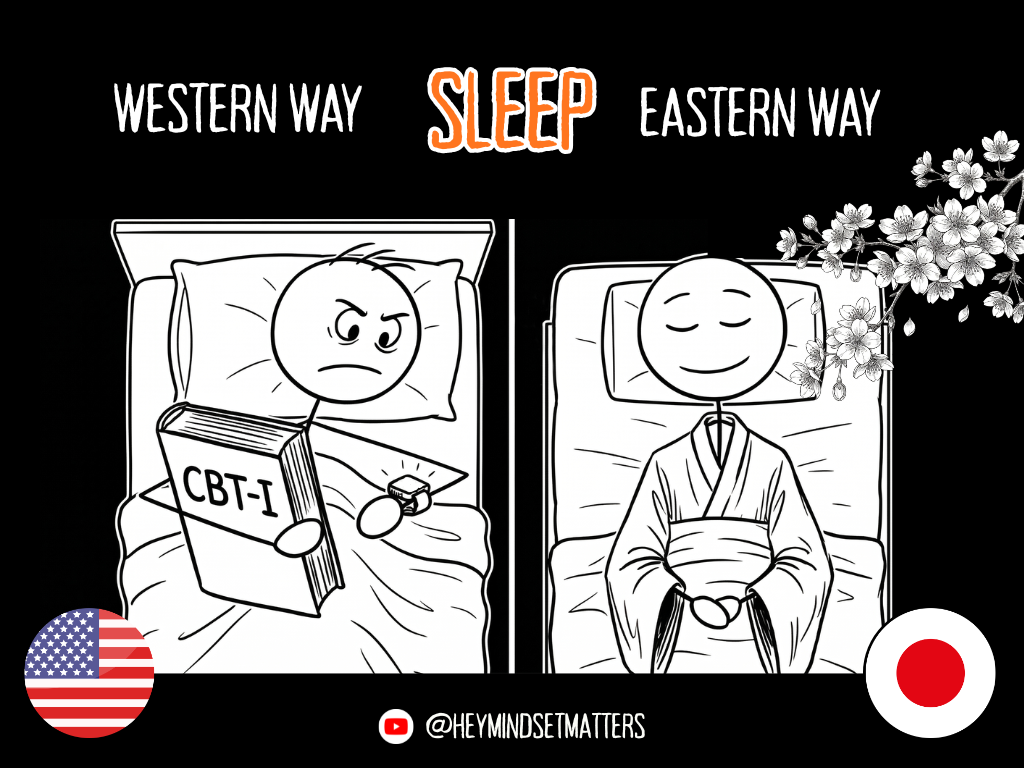
Decoding the Cognitive Loops: How Japanese Sleep Methods and Science Create Better Sleep
We have all been there. You lie down, physically exhausted, only to find your thoughts spiraling into an endless, unyielding loop. Observing our own thought patterns—thinking about how we think—is the first crucial step to achieving better sleep. If you are dealing with sleep deprivation, you are likely intimately familiar with the racing mind. Today, we are exploring how integrating CBT-I / Cognitive Behavioral Therapy for Insomnia with Japanese sleep methods can help you step back, analyze your cognitive habits, and reclaim your rest.
If you haven’t watched the companion video yet, you can watch it below or check it out on our YouTube channel here: Watch ‘The Secret Japanese Habits That Stop a Racing Mind’ on YouTube.
If you like this type of content, and would like to watch our future videos, please subscribe to the Hey Mindset Matters YouTube channel and ring the notification bell so you’re notified each time we drop a new video.
The Architecture of Sleeplessness
Before we can consciously restructure our nighttime habits, we must observe the baseline of the problem. According to the latest 2026 data, the most common reason for sleep deprivation in America is stress and anxiety.
- Nearly 3 in 4 Americans (74%) report that stress and a racing mind are the primary barriers to getting a full night’s rest.
- For stress and anxiety, people report the main concerns being financial worries, work pressure, and the inability to silence their thoughts.
- Mental health remains the #1 disruptor; surveys show that even when people have the time to sleep, the inability to “switch off” prevents them from resting.
Culturally, we are reaching a tipping point. Audiences have realized that hyper-optimized, 5:00 AM routines were making them miserable. Today, Japanese aesthetics and mindfulness routines represent the exact antidote to modern burnout – a rebellion against hustle culture.
To achieve cognitive quiet, 2026 clinical guidelines emphasize that changing behavioral and mental patterns is the only long-term cure. CBT-I / Cognitive Behavioral Therapy for Insomnia provides the scientific framework, while Japanese sleep methods provide the sensory tools to execute that framework effectively. Let us examine three specific strategies to restructure your approach to rest.
Strategy 1: Tackling Abstract Stressors (Kakeibo + Constructive Worry)
Financial worries and work pressure are distinct beasts. In the clinical world of CBT-I, these specific stressors cause Cognitive Arousal – your brain literally perceives a threat to your survival and refuses to power down the nervous system to let you sleep.
- The Japanese Method: Kakeibo (The Mindful Ledger). Invented in 1904, Kakeibo is a mindful practice. It forces you to sit down with pen and paper and reflect on your finances, treating money management as an act of self-awareness rather than a mere math problem.
- The CBT-I Match: Constructive Worry. CBT-I dictates that you cannot bring abstract worries into the bedroom. You must schedule a 15-minute window during the day to write down your anxieties and the immediate next step to solve them.
The Synthesis: Use the Kakeibo method during your CBT-I Constructive Worry window. By physically writing down your financial fears a few hours before bed, you move the stress out of the amygdala (the panic center) and into the prefrontal cortex (the logic center).
Strategy 2: Quieting the Brain in Bed (Morita Therapy + Paradoxical Intention)
This strategy applies when you are already in bed and your brain will not stop looping over a conversation or an upcoming deadline.
- The Japanese Method: Morita Therapy. Developed in the 1920s, this psychological framework is based on Zen principles. Its core tenet is Aru ga mama—accepting reality exactly as it is. Morita Therapy teaches that trying to control or suppress your thoughts only makes them stronger.
- The CBT-I Match: Paradoxical Intention. In CBT-I, the biggest enemy of rest is what we might call performance anxiety sleep—the stress of trying to fall asleep. Paradoxical Intention is a technique where you intentionally stop trying to sleep and instead just lie quietly with your eyes open.
The Synthesis: When the racing mind hits at 2:00 AM, apply Aru ga mama. Observe the racing thoughts as if they are weather passing outside a window. By giving up the desperate fight to control your mind, you remove the emotional friction; ironically, this acceptance causes your heart rate to drop, allowing the biological sleep drive to take over.
Strategy 3: Overcoming Overwhelm (Kaizen + Cognitive Closure)
Work pressure ruins sleep when we feel we didn’t accomplish enough during the day, leaving a daunting mountain of tasks for tomorrow.
- The Japanese Method: Kaizen. This is the philosophy of making impossibly small, incremental steps forward to bypass the brain’s fear response.
- The CBT-I Match: Cognitive Closure. CBT-I requires you to draw a hard psychological boundary between work time and sleep time.
The Synthesis: End your workday with a Kaizen ritual. Instead of staring at a massive to-do list, write down the single smallest step you will take at 9:00 AM. This satisfies the brain’s need for progress and creates the Cognitive Closure required to enter your nighttime routine without guilt.
Referenced Resources
- Cognitive Behavioral Therapy for Insomnia (CBT-I) protocols and guidelines from the American Academy of Sleep Medicine.
- Morita Therapy and the True Nature of Anxiety-Based Disorders by Shoma Morita.
- Kakeibo: The Japanese Art of Saving Money by Fumiko Chiba.
- The Spirit of Kaizen: Creating Lasting Excellence One Small Step at a Time by Robert Maurer.
Final Thoughts
To overcome sleep deprivation and secure better sleep, we must become active observers of our own cognitive patterns. A racing mind driven by stress and anxiety is often just a symptom of a brain trying to solve abstract problems in the wrong environment. By consciously applying Japanese sleep methods alongside CBT-I / Cognitive Behavioral Therapy for Insomnia, you can bypass hustle culture and burnout. Detach from the noise, observe your thoughts impartially through Aru ga mama, and give your nervous system permission to rest. Learning to step outside your own thought loops takes practice, but the profound clarity is well worth the effort.
Other articles of interest…
- The Secret Motivational Trick – Let’s Hack the Formula
- How to Finally Stop Procrastinating: Five Psychology-Backed Strategies That Actually Work